
Military Wireless Communication Project – Multi-Team RF Command System

Original price was: ₹7,500.00.₹5,600.00Current price is: ₹5,600.00.
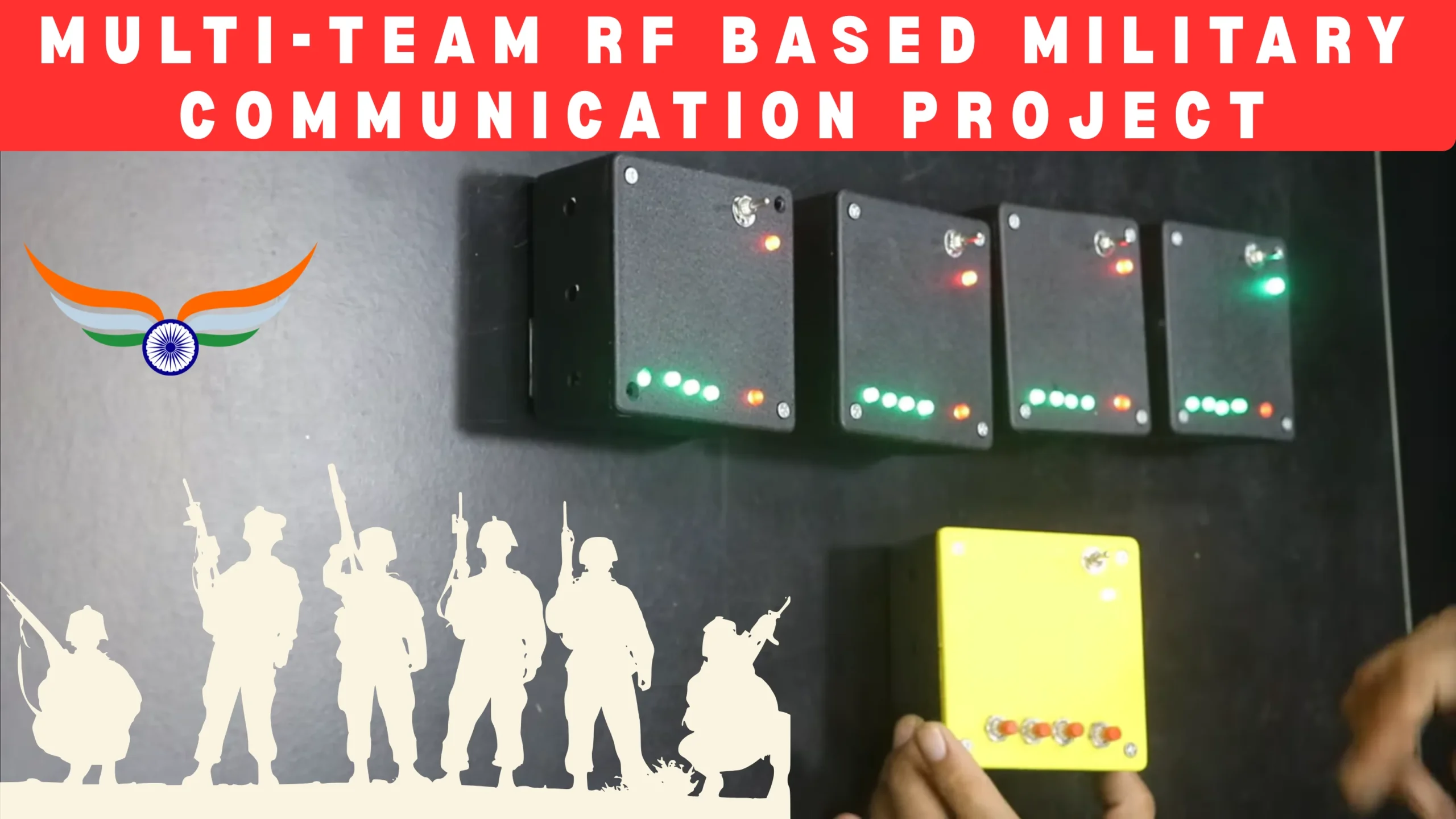
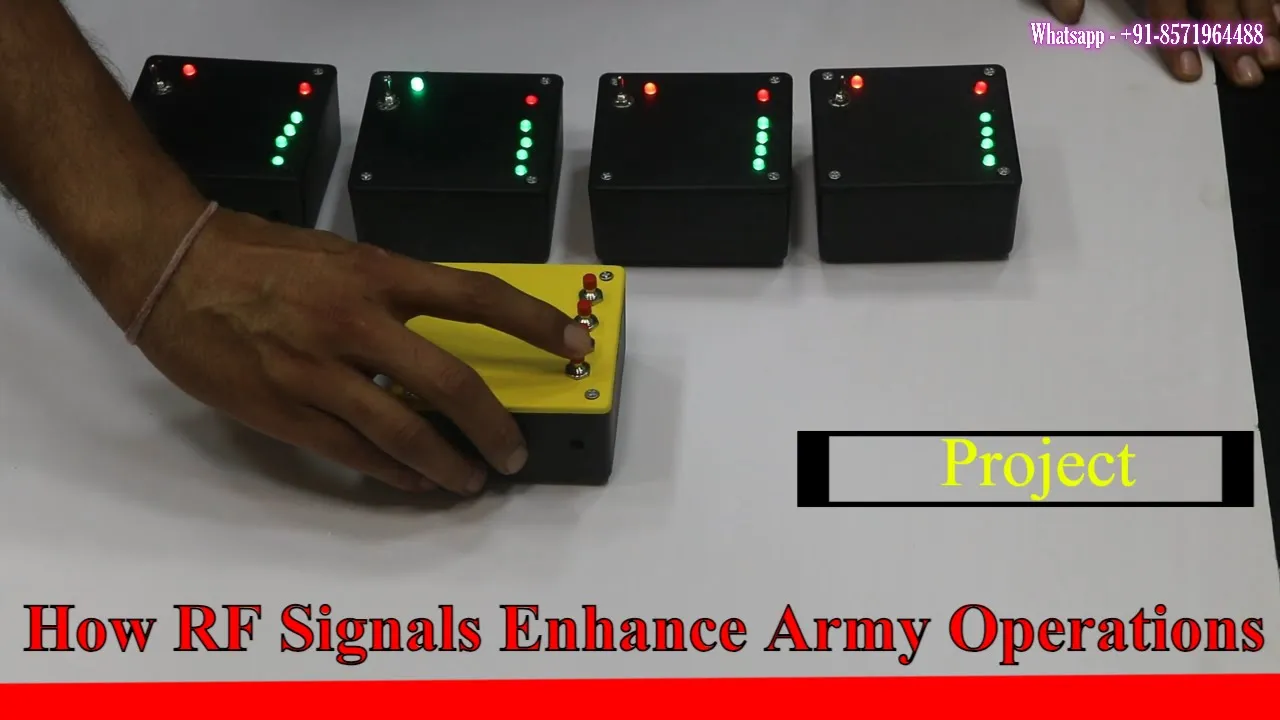
This military wireless communication project 🪖📡 is an innovative RF-based multi-team command system designed for real battlefield coordination. Using a single RF transmitter at the commander’s end and four independent RF receiver modules for four teams, this project enables encrypted wireless alerts, fast signaling, and secure team-wise communication. Each team receives all transmitted data but only responds to its assigned 4-bit RF signal, decoded using HT12E and HT12D encoder-decoder ICs. Whenever the commander presses a button, the respective team’s LED indicator activates instantly ⚡.
This project comes fully assembled, includes PPT, report, video demo, future scope, theory material, and is ideal for B.Tech, Diploma, M.Tech, ITI, and school-level exhibitions. A perfect demonstration of secure RF communication used in modern defense systems 🚀.
496 in stock
The military wireless communication project 🪖📡 is a practical and highly relevant engineering system designed to demonstrate how army units coordinate in real war-zone conditions using secure radio frequency (RF) signaling. Today’s battlefield requires clear, fast, and encrypted communication, and this project replicates the same idea in a simple, academic-friendly format. It uses RF transmitter and receiver modules along with HT12E (encoder) and HT12D (decoder) ICs to send commands from a commander to four separate field teams.
In real missions, the commander coordinates multiple squads positioned across the battlefield. This project replicates exactly that concept: one commander → four teams → four receivers → encrypted RF signaling.
This makes it an ideal learning system for students who want to understand wireless communication, RF technology, encoding/decoding, and military-grade signaling.
How the Multi-Team RF Communication Works
The working is simple but brilliant 👌:
1. One Transmitter, Four Receiver Units
The commander carries a single RF transmitter remote with four push buttons. Each button corresponds to one team.
On the battlefield, each team captain holds one RF receiver unit.
Even though all receivers get the same RF data (because RF signals radiate in all directions), each team only reacts to its assigned 4-bit code.
2. Use of HT12E and HT12D ICs
This is the heart of the system:
HT12E (Encoder) – Converts button press into a 4-bit RF data packet
HT12D (Decoder) – Present in all four receivers, identifies and outputs the correct 4-bit command
This ensures data accuracy and team-specific signaling.
Step-by-Step Working Sequence
Commander presses Button 1 → HT12E encodes Signal 1 → RF transmitter broadcasts it
All four receivers capture the signal
Each HT12D decodes the packet
Only Team 1’s “assigned bit” activates
LED indicator turns ON indicating that team’s command
Same logic for Team 2, Team 3, and Team 4
This creates an efficient military wireless communication project setup that mimics real-life field operations.
Components Used in the Project
🧰 Key Components Include:
RF Transmitter Module (433 MHz)
RF Receiver Module (4 units)
HT12E Encoder IC
HT12D Decoder IC (4 units)
Push Button switches
LED indicators
Power supply
PCB board
Supporting resistors, capacitors, connectors
Real-World Applications
This military wireless communication project is a perfect example of real defense communication systems, and can be used for:
Army communication demonstrations
Multi-squad coordination
Encrypted remote signaling
Secure team-wise alerts
Defense exhibitions and innovation fairs
For engineering students, this project gives hands-on experience with wireless electronics and defense-grade communication logic.
Educational Value and Learning Outcomes
Students learn:
RF transmission and reception
Digital encoding and decoding
Wireless data flow
Remote signaling concepts
Battlefield communication logic
Team-specific RF control
Practical troubleshooting and testing
Perfect for B.Tech, M.Tech, Diploma, Polytechnic, ITI, and school science exhibitions.
🎥 Project Demonstration Video
🔗 Internal Resource Links
🌐 External Reference (DoFollow)
📚 References / Further Reading
❓ Frequently Asked Questions
1. How does the Military Wireless Communication Project ensure that each team receives only its assigned signal?
This military wireless communication project uses HT12E (encoder) and HT12D (decoder) ICs to send and decode a specific 4-bit digital code for each team. Although all receivers capture the same RF broadcast, the decoder in each unit activates only when its predefined bit pattern matches the transmitted code. This ensures that Team 1, Team 2, Team 3, and Team 4 each receive only their assigned command, preventing cross-triggering and ensuring precise field coordination.
2. What makes this project suitable for defense-related demonstrations and engineering students?
The project demonstrates real-world military signaling principles using RF technology, making it ideal for academic learning. Students understand concepts like wireless data transmission, encoding, decoding, and team-based communication systems used in defense. It is fully assembled, easy to demonstrate, and includes documentation, making it perfect for B.Tech, M.Tech, Diploma, Polytechnic, ITI, and school-level exhibitions.
3. What components are included in this Multi-Team RF Command System?
This military wireless communication project includes one RF transmitter module, four RF receivers, HT12E encoder IC, four HT12D decoder ICs, LEDs for team indication, push-button switches, PCB boards, a regulated power supply, wires, and connectors. Every unit is tested and delivered fully assembled so students can directly learn, test, and present it without requiring soldering or coding.
4. Can this wireless communication system work over long distances?
Yes, the project uses standard 433 MHz RF modules, which can communicate over long distances depending on the environment. In open outdoor conditions, the range can go from 50 to 100 meters, making it highly useful for demonstrations, field testing, and exhibitions. The range can also be extended using RF amplifiers or antennas, allowing it to mimic real defense signaling.
5. Does the project come with documentation and video support for viva and submission?
Yes. The kit includes a complete project report, PPT presentation, theory explanation, block diagram, circuit diagram, and English video demonstration. This ensures students understand the logic, can answer viva questions confidently, and can demonstrate the military wireless communication project professionally during exams, competitions, or exhibitions.
Related products
Electrical Engineering Projects
DC Motor Speed Control using Arduino PWM and TIP122 Transistor with LCD Display
Best Selling Engineering Projects
Electrical Engineering Projects
Automatic Power Factor Correction Project Using Arduino | APFC Project For Electrical Engineering

Arduino Based Projects
Anti-Sleep Alarm: Eye Blink Detection Project for Drowsiness Prevention #1

Best Selling Engineering Projects
LCD Based Smart Electronic Voting Machine Project using 8051 Microcontroller
Electronics Engineering Projects
Electrical Engineering Projects
Hybrid Solar and Wind Power Generation System Engineering Project


Electrical Engineering Projects
Vehicle Automatic Headlight Control Project (High Beam Low Beam System)