
Projects Without Microcontroller Blogs, Electrical Engineering Project Blogs, Mechanical Engineering Project Blogs
Vehicle Automatic Headlight Control System – Smart Safety Project Guide
Jan
🧠 Introduction
The Vehicle Automatic Headlight Control System is a clever, student-friendly electronics project that helps reduce road hazards by switching between high beam and low beam automatically 🚗💡. Using an LDR sensor, LM358 comparator, and relay mechanism, this system ensures you get full visibility when needed, but won’t blind oncoming drivers when there’s traffic ahead.
With road safety as a growing concern, especially during nighttime driving, the Vehicle Automatic Headlight Control System using an LDR sensor offers a modern solution to an age-old problem. Driving at night can be challenging due to limited visibility and the glare from high-beam headlights. Traditional manual headlight adjustments can be inconvenient and unsafe, leading to accidents or distracting oncoming drivers. This project addresses these issues with an automatic headlight dimming system that utilizes an LDR sensor, LM358 comparator, relay, and dual headlights to adjust headlight intensity based on real-time light conditions. This innovative engineering project is both cost-effective and efficient, making it ideal for engineering students looking to create a valuable and impactful project.
⚙️ Project Objective & Overview
In night-time driving or poorly lit roads, misuse of high beams can cause glare, accident risk and traffic fines. This project is designed for engineering students (school, B.Tech, Diploma, hobbyists) to build a ready-to-use hardware kit that automates headlight beam switching without any coding required. It blends electronics and automotive safety into one practical learning system.
Components Used in the Vehicle Automatic Headlight Control System
- LDR Sensor (Light Dependent Resistor): The LDR sensor is the core of the headlight control system, sensing ambient light levels. The LDR’s resistance decreases as the light intensity increases, allowing it to detect when it’s dark enough for high-beam headlights or when there’s an oncoming vehicle.
- LM358 Comparator Module: The LM358 operational amplifier serves as a comparator. It compares the voltage generated by the LDR with a predefined threshold. If ambient light is low, the LM358 signals the relay to turn on high beams. When oncoming lights are detected, it adjusts the headlights to low beams, reducing glare.
- Relay Module: Acting as an electronic switch, the relay controls the transition between high and low beams, depending on signals from the LM358 comparator.
- Dual Headlights: This setup represents the high and low beams and demonstrates how the system would function in an actual vehicle, providing optimal lighting conditions based on real-time road scenarios.
- Power Supply (5V and 12V): The project requires a 5V power supply for the LM358 module and relay control, while a 12V power supply powers the headlights, simulating real-world automotive lighting voltage.
📦 Related Products / Resources
👉 Buy Fully Assembled Vehicle Automatic Headlight Control System🪄 How it Works (Step-by-Step Explanation)
- Here’s a breakdown of the logic behind the Vehicle Automatic Headlight Control System:
- The LDR sensor is placed to detect oncoming vehicle light.
- When the light intensity rises above a threshold (due to an oncoming vehicle’s beam) the LDR’s resistance drops.
- The LM358 comparator IC monitors the LDR output against a preset reference (via potentiometer).
- If the sensor voltage crosses the threshold, the LM358 triggers the relay.
- The relay shifts from high beam to low beam (or vice-versa depending on conditions).
- The system stays in that state until the sensor voltage returns below/above threshold—thus making the headlight switching automatic and seamless.
- Optional features: a timer or buzzer can be added to alert the driver or automatically revert beams after a duration.
Download:- Synopsis of the project
Download:- PPT of the Project
Circuit Diagram
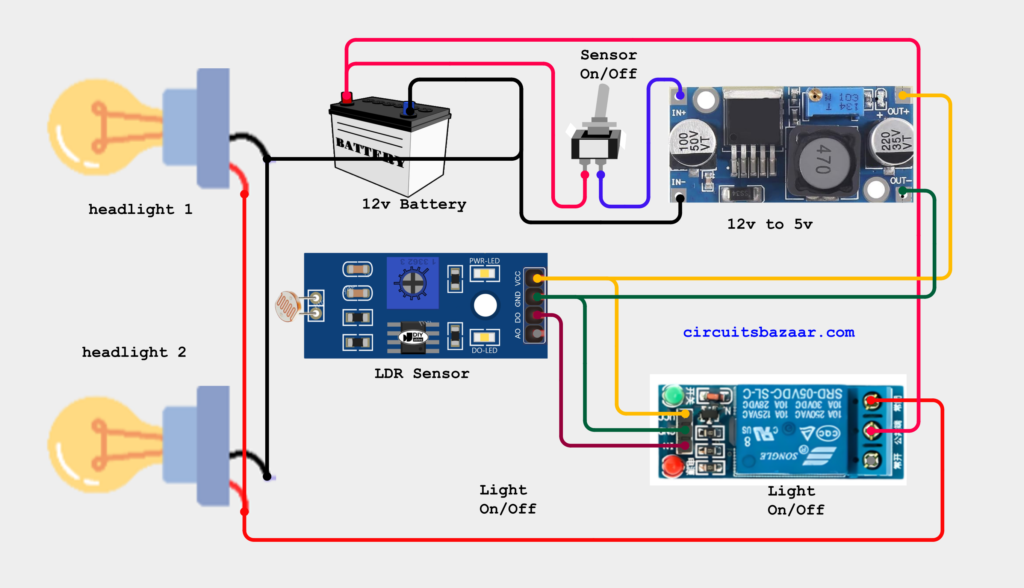
How the Vehicle Automatic Headlight Control System Works
This automatic headlight dimming system operates by continuously monitoring ambient light levels and switching the headlights accordingly:
- Light Detection: The LDR sensor constantly measures the ambient light. Under low light conditions, the LDR’s resistance increases, causing the LM358 to send a signal to the relay to activate high beams.
- High Beam Control: When light levels are low (e.g., at night), the LM358 triggers the relay to switch on the high beams, ensuring optimal visibility for the driver.
- Detection of Oncoming Vehicles: When oncoming headlights are detected, the LDR responds to the increased light intensity, and the LM358 switches the relay to low beam, reducing glare for oncoming drivers.
- Reverting to High Beam: After the oncoming vehicle passes, the LDR senses the reduction in light, causing the LM358 to signal the relay to switch back to high beam, maximizing visibility for the driver once again.
This engineering project provides a hands-free, responsive system that enhances driver convenience and road safety.
📦 Related Product Link
👉 Buy Fully Assembled Vehicle Automatic Headlight Control System Kit from Circuits Bazaar🎥 Project Demonstration Video
🎬 Hindi Demonstration 👇
🎬 English Demonstration 👇
🎬 Alternate Demo 👇
🎬 English Demonstration 👇
👉 https://youtu.be/_jAAgjsDfek
Applications of the Headlight Control System
The Vehicle Automatic Headlight Control System has various practical applications, including:
- Automotive Industry: This system is a perfect addition to vehicles, offering an innovative headlight control solution for nighttime driving safety.
- Motorcycle Safety: For two-wheelers, this system can improve rider visibility and reduce glare, making it suitable for motorcycle enthusiasts looking for advanced headlight solutions.
- Commercial and Fleet Vehicles: Long-haul trucks and fleet vehicles can incorporate this headlight dimming system to enhance visibility and safety on highways and rural roads.
Advantages of the Vehicle Automatic Headlight Control System
- Enhanced Road Safety: By adjusting headlights automatically, the system reduces glare and ensures drivers have optimal visibility, significantly lowering the risk of accidents.
- Hands-Free Operation: This automatic system eliminates the need for manual adjustment, allowing drivers to focus fully on the road.
- Energy Efficiency: With automatic control, the headlights use high beams only when necessary, conserving energy and extending the life of the vehicle’s lighting components.
- Cost-Effective Solution: This project is designed with affordable components, making it an economical choice for engineering students and automotive manufacturers.
Disadvantages of the Automatic Headlight Control System
- Environmental Interference: Bright streetlights or reflective surfaces may sometimes trigger the low beam unintentionally, causing unnecessary dimming.
- Component Durability: Repeated switching between high and low beams may wear out the relay, requiring occasional replacement.
- Limited Adaptability in Adverse Weather: The LDR sensor may not detect low visibility caused by rain or fog, potentially limiting its performance under certain weather conditions.
Future Scope of the Vehicle Automatic Headlight Control System LDR Sensor
The Vehicle Automatic Headlight Control System has promising future developments:
- Integration with Advanced Driver Assistance Systems (ADAS): Integrating this system with ADAS technology could allow it to adapt to real-time road conditions and detect other vehicles with enhanced accuracy.
- Weather-Adaptive Lighting: By incorporating additional sensors for rain, fog, or snow, the system could dynamically adjust lighting for improved visibility in all conditions.
- Wireless Connectivity and Diagnostics: Adding wireless capabilities could allow users to monitor and control the headlight system remotely, receiving alerts on maintenance or malfunction.
- Multiple Light Sensors for Improved Accuracy: The addition of more light sensors and a microcontroller could further enhance the system’s ability to differentiate between ambient light sources, reducing false triggers.
Conclusion
The Vehicle Automatic Headlight Control System Using LDR Sensor is a simple yet effective project that addresses key nighttime driving safety challenges. By automatically controlling headlight intensity, it minimizes driver distraction, reduces glare for oncoming vehicles, and enhances visibility. The system’s practical and cost-effective design makes it an ideal innovative engineering project for students. With further developments and integration into automotive technology, this automatic headlight control system could become a standard feature in vehicles, promoting safer roads for everyone.
This project not only provides hands-free control and energy efficiency but also holds significant potential for enhancing road safety in future applications.
📦 Related Products / Resources
🔗 Internal Resource Links
🌐 External Reference (DoFollow)
📚 References / Further Reading
❓ Frequently Asked Questions
Q1. How does the vehicle automatic high beam low beam control system work?
The vehicle automatic high beam low beam control system uses an LDR sensor, comparator IC (LM358), and a relay to switch the headlight beam automatically. The LDR detects incoming vehicle light, creates a voltage change, and the LM358 compares it with the set threshold. When bright light is detected, the system shifts to low beam automatically. This prevents glare, improves road safety, and makes night driving smoother for everyone. ⚙️💡
Q2. Can I use this system in any vehicle for practical demonstration?
Yes! This project is fully compatible with bikes, scooters, and cars for educational demonstration. Since it runs on a 12V battery, you can easily show how automatic beam shifting works using any vehicle’s DC supply. Engineering students often use it on a wooden base model rather than an actual vehicle for safety and convenience. 🚗🔧
Q3. What components are essential in the vehicle automatic high beam low beam control project?
The main components include an LDR sensor, LM358 comparator IC, a relay module, 12V headlights, a 12V battery, a 5V regulated supply, and a potentiometer for threshold adjustment. Each part works together to sense ambient light and switch the headlights automatically between high and low beams. 🔋✨
Q4. Can this project be enhanced with modern features like IoT or microcontrollers?
Absolutely! You can upgrade the vehicle automatic high beam low beam control project by adding Arduino, ESP32, or GSM alerts. Features such as distance measurement using ultrasonic sensors, ambient-light calibration, mobile notifications, and automatic fog-light activation can be added to make it more advanced. 🌐🤖
Q5. Is this project suitable for diploma and B.Tech final-year submissions?
Yes, this project is highly suitable for Diploma, B.Tech, M.Tech, ITI, and school-level exhibitions. It explains sensors, comparators, power supply design, relay switching, and real-world vehicle automation — all important for viva and presentation. Students can easily demonstrate its working and scoring potential is very high. 🎓🚀